
The Five-Minute Home Check Close Protection Officers Swear By
Close Protection officers do not assess a property by wandering around feeling uneasy. They walk a set route, in a set order, looking for specific things. Here is that method, scaled to an ordinary home, and it genuinely takes five minutes.
How professionals actually think
Three questions, in order: what would deter someone from trying, what would detect them if they did, and what would delay them long enough for the detection to matter. Almost every recommendation in the industry is one of those three, and the cheapest wins are nearly always in deterrence and detection rather than in heavier locks.
The other professional habit worth stealing: assess from the outside in, in the order an outsider would experience it. It is remarkably hard to see your own home objectively when you start at the sofa.
Minute one: the approach
Stand on the pavement and look at your home as a stranger. What can you see? Is there post with your full name visible through the glass, a parcel on the step, an open window on a hot day, a laptop visible from the street? Can you tell from outside whether anyone is in?
Look at how a person would get from the street to your door unobserved. High hedges and fences feel private, and privacy for you is also cover for someone else. Trimming a hedge to below chest height is free and does more than most gadgets.
Minute two: the entry points
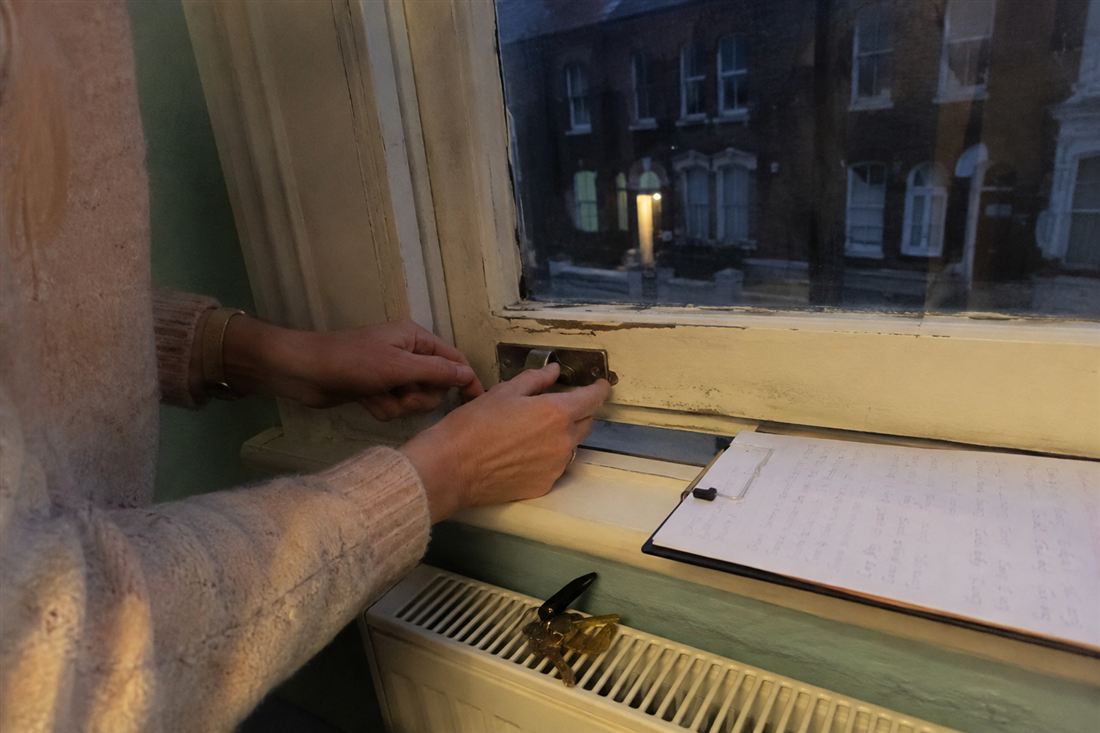
Walk the perimeter. Every door and every window at ground level, plus anything reachable from a bin, a wall, a flat roof, a balcony or a drainpipe. For each one, ask only: does it lock, and is it locked?
Then look for the weak link that is not a lock — a cat flap next to a door handle, a key on a hook visible through a letterbox, a side gate that is bolted only on the outside, a shed containing tools that would open the rest of the house.
Minute three: lighting
Do this bit at night, once. Where are the dark patches on the approach to your door, at the side gate, by the bins, at the parking space? Lighting is the highest-return security purchase there is, because it works on all three layers at once: it deters, it lets you and your neighbours detect, and it removes the cover someone needs to work on a lock unseen.
Motion-activated is better than always-on — the change is what draws attention.
Minute four: sightlines and the neighbours
Who can see your front door — a neighbour's window, a passing bus route, a well-used footpath? Overlooked is safe. Then ask the practical version: is there at least one person nearby who would recognise that something was wrong, and do you have their number?
This is the single most under-rated security measure in existence, and it costs nothing but a conversation.
Minute five: your own routine
Finally, look at the patterns you create. Do you leave and return at exactly the same times? Is your bin out the same evening with your address on parcels in it? Do you post about being away while you are away, rather than after? Do you have one route you always take, at one time, alone?
You do not need to live unpredictably. You just need to know which of your patterns are visible from outside, and vary the ones that make you easy to plan around.
What to do with what you find
Write down everything you noticed, then sort it into three piles: free today, cheap this month, and needs a landlord or a professional. Do the free pile immediately — closing curtains before lights, moving a key, cutting a hedge, bolting a gate from the inside — and you will usually have closed most of the gap before you have spent anything.
Pink members can send the results of this walk-through to a working Close Protection specialist and get a prioritised list back, which is the same service, done properly, that principals pay for.
In immediate danger? Call 999. Her Security is an education platform and community — for urgent help we always recommend the police, NHS 111 or a specialist crisis line.
← All stories