
Securing Any Room: Hotel, Flat or Halls, in Minutes
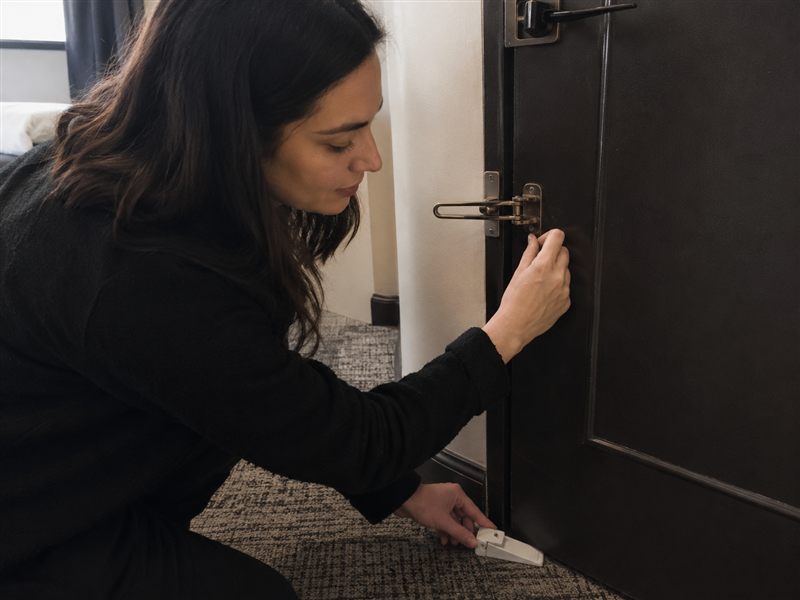
Whether it is a hotel for one night or a flat for a year, the assessment is the same: how does someone get in, would you know, and what would you do. Everything else is detail.
Three layers, in order
Security professionals think in layers — deter, detect, delay. You do not need the vocabulary, but the order is useful, because it stops you spending money on the wrong thing. A £4 door wedge that wakes you up is worth more than a £200 lock you never engage.
Layer one: the door
The door is where almost everything happens, and where almost all of the easy wins are.
- Lock it and test it. Every time. Pull the handle. A door that has not quite latched looks identical to one that has.
- Use the secondary lock. Chain, bar, deadbolt, latch — whatever is there. The primary lock is the one a key opens; the secondary is the one that stops a key being enough.
- Know who has a key. In a rented flat, ask the landlord directly whether the locks were changed after the last tenant. If the answer is vague, changing a euro cylinder is inexpensive and you can usually take it with you.
- Never open to an unexpected caller. Verify through the peephole or by phoning the front desk, the company or the building manager on a number you looked up yourself — not one the caller gave you.
Layer two: everything else that opens
Ground-floor windows, anything reachable from a bin store, flat roof, balcony, drainpipe or neighbouring garden, and any communal door propped open for convenience. Check each one actually locks rather than merely closes. Painted-shut windows are a fire risk, not a security feature — flag them to whoever is responsible.
In shared buildings, the weakest point is usually social rather than physical: the main door held open for someone carrying shopping. You are allowed to let it close. "Sorry, I don't know you" is a complete sentence, and anyone who lives there has a key.
Layer three: the routine
Lights on a timer so the place is never obviously empty at dusk. Curtains closed before you turn the lights on, not after. Post not building up. Keys never left under a mat, in a pot, or on a hook by the letterbox where they can be fished through. Deliveries to a locker or a neighbour rather than your name and flat number sitting in a porch all afternoon.
The portable kit
Three things fit in any bag, cost very little, and work in a hotel, a hostel, an Airbnb or a halls room where you cannot change anything permanent:
- A rubber door wedge — stops an inward-opening door even against a key.
- A portable door alarm — hangs on the handle or wedges under the door, and screams if the door moves. This is your detection layer.
- A small torch — power cuts, unfamiliar corridors, dropped keys.
What to ask before you commit
Renting: were the locks changed, who else holds keys, is there a working communal door entry, what is the lighting like on the approach after dark. Hotels: ask not to have your room number said aloud at check-in, and ask for a room that is not on the ground floor and not at the far end of an unstaffed corridor. Both requests are completely routine and no good hotel will blink.
Halls, specifically
Student halls are a special case, because the culture is openness and the doors are constantly propped. Lock your room even when you are down the corridor — most incidents in halls are opportunistic and involve a door left open for two minutes. Find out how to contact your security team and put the number in your phone on day one, not on the night you need it.
In immediate danger? Call 999. Her Security is an education platform and community — for urgent help we always recommend the police, NHS 111 or a specialist crisis line.
← All stories